
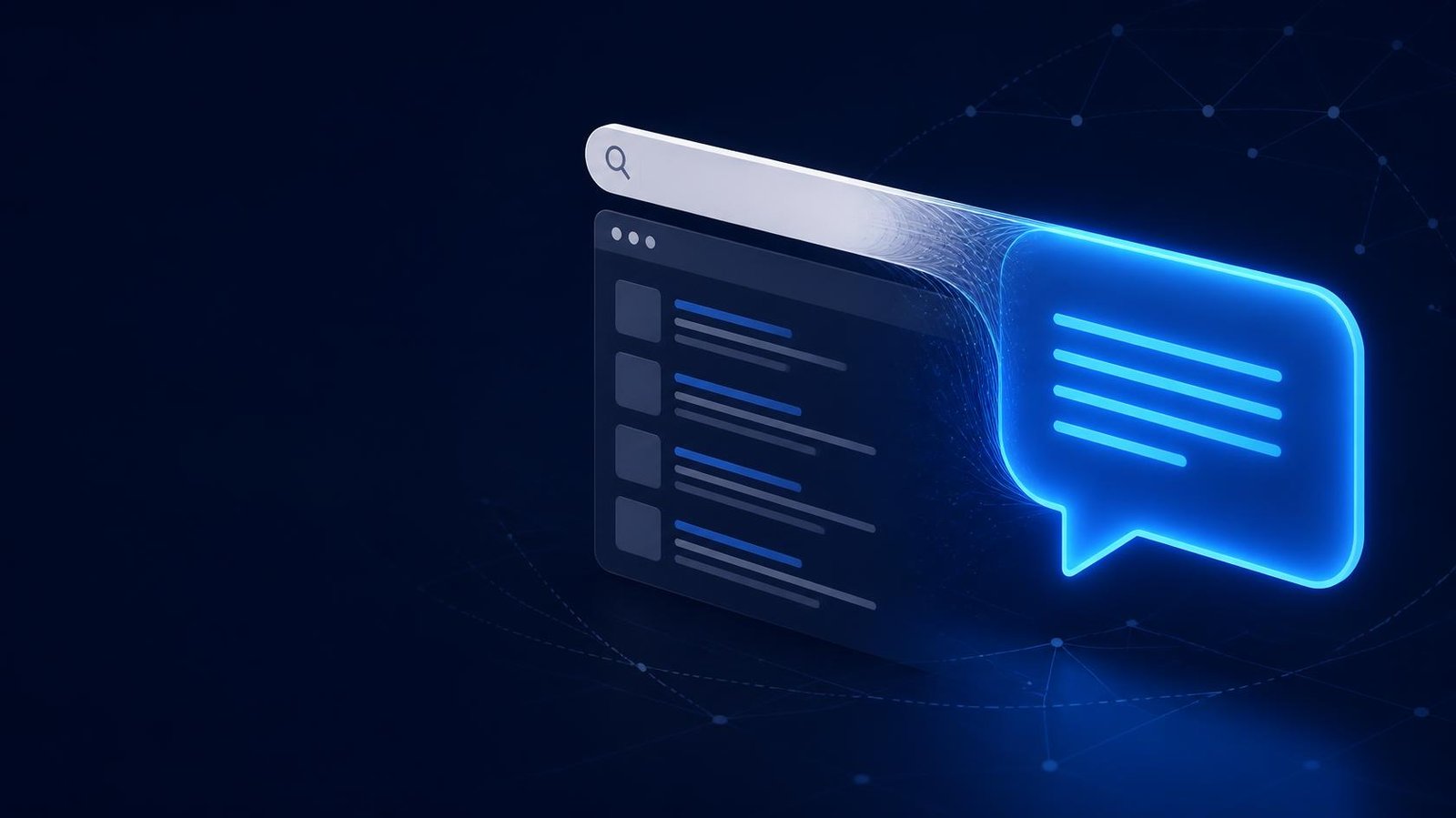
Quick answer: AEO (Answer Engine Optimization) and GEO (Generative Engine Optimization) are ways of shaping your website so that AI tools like ChatGPT, Google’s AI Overviews, and Perplexity mention your business when someone asks a question. Regular SEO gets you a ranking. AEO and GEO get you quoted.
I want to walk you through this the way I’d explain it to a client over coffee, not the way a big agency would, with ten acronyms and no real answer.
Why This Matters Now, Not Later
A few years ago, ranking on page one of Google was the whole game. That’s changing fast. Ahrefs found that AI overviews reduced click-through rates for top-ranking Google content by 58%, up from about 34.5% the year before. In plain words: even if your website is the best answer, fewer people are clicking through to see it, because Google (or ChatGPT, or Perplexity) is just answering the question right there.
Chat GPT alone now processes 2.5 billion prompts a day, and about 65% of those work like a search. A lot of your future customers aren’t typing into Google anymore. They’re asking an AI assistant, “Who’s a good local SEO expert in Kuwait?” or “Best security company near me.”
If your website was never written with that question in mind, you’re invisible to them, even if you rank fine on Google.
What Do AEO and GEO Actually Mean?
These terms are new enough that even experts don’t fully agree on where one ends and the other begins. As of early 2026, there’s no single agreed definition, and the terms are often used interchangeably in the industry. Here’s how I use them with clients:
- AEO (Answer Engine Optimization): writing your content so it can be pulled out as a short, direct answer, like Google’s featured snippets or AI Overviews.
- GEO (Generative Engine Optimization): the bigger goal of getting an AI system to actually cite your business by name when it writes out a full answer, inside tools like ChatGPT or Perplexity.
In everyday practice, the two overlap a lot. AEO is the narrower, more answer-specific piece. Think of AEO as writing a good, quotable sentence, and GEO as making sure the AI trusts you enough to say your name out loud.
Is This Just Replacing SEO?
No, and I’d be careful of anyone who tells you to throw out your old SEO work. Even Google has said this directly: in 2026 documentation, Google described optimizing for generative AI search as still being, fundamentally, SEO. AEO and GEO build on top of solid SEO. They don’t replace it.
If your website has no real structure, slow pages, or thin content, no AI trick will fix that. AEO and GEO are the next layer, not a shortcut around the basics.
How Do AI Systems Decide Who to Quote?
This is the part clients ask me most. From what I’ve seen, and what current research backs up, it comes down to a few things:
- Clear, direct answers. If someone asks “How much does local SEO cost?” and your page buries the answer under three paragraphs of fluff, the AI will skip you for a page that answers in the first two sentences.
- Consistency about who you are. AI systems check whether your business name, services, and descriptions stay consistent everywhere they appear, not just on your own site. If your website calls it “local SEO,” your Google Business Profile calls it “search marketing,” and a directory calls it something else again, that confuses the AI about whether it’s even the same business.
- Structure that’s easy to lift. Clear headings, short paragraphs, bullet points, and FAQ sections are far easier for an AI to pull a clean answer from than one giant wall of text.
- Being genuinely useful. Structured data can help an AI understand your page, but it does not guarantee you’ll be cited. Content quality, relevance, and trust still matter more than any technical trick.
Simple Ways to Start (Without an Agency Contract)
You don’t need a big budget to begin. Here’s what I actually do for clients:
- Answer the real question in the first two sentences. Don’t make people, or AI, scroll to find it.
- Use headings that sound like questions. “What is local SEO?” beats “Our Local SEO Philosophy” every time, for both AI and normal readers.
- Add a short FAQ section to your key pages. It’s one of the easiest ways to get pulled into an AI answer.
- Keep your business details the same everywhere, your website, Google Business Profile, and any directories.
- Update your important pages every so often. Stale pages fall out of AI answers faster than you’d think.
A Word of Caution
No one can guarantee your business will show up in an AI answer. Anyone who promises that is not being honest with you. I won’t tell you that either. What I can tell you is that businesses doing the basics well, clear answers, consistent information, real usefulness, show up far more often than businesses ignoring this completely.
Quick Questions People Ask Me
Does AEO replace SEO?
No. It builds on it. A site with weak SEO foundations won’t succeed at AEO either.
Do I need special software for this?
Not to start. Clear writing, consistent business details, and a good FAQ section will take you most of the way.
Will this work overnight?
No. Like regular SEO, it takes time for AI systems to notice and trust the changes.